In the first 24 hours after a crash, your only job is your health. Accept medical care, and do not give the other driver’s insurance company a recorded statement until you have spoken with an attorney. Those early choices can shape how an insurer values your claim for months afterward.
Insurance companies move quickly after a collision. Adjusters often call within hours, when you are still shaken, in pain, and unsure what happened. Knowing what to expect gives you a real advantage.
Why the First 24 Hours Matter for Your Car Accident Claim
After a crash in Chicago, Cook County, or DuPage County, many people try to push through. They worry about the car, the rental, the phone calls, and work. Your health is the priority, and it is also the foundation of your claim.
Insurers evaluate injury claims by looking at when you got treatment, what you told them, and how consistent your story is. A gap or an offhand comment in the first day can later be used to argue that your injuries are minor. Our car accident lawyer page explains how these claims are built from the start.
What Should You Do Right Now After a Car Accident?
Use this checklist at the scene and in the hours that follow:
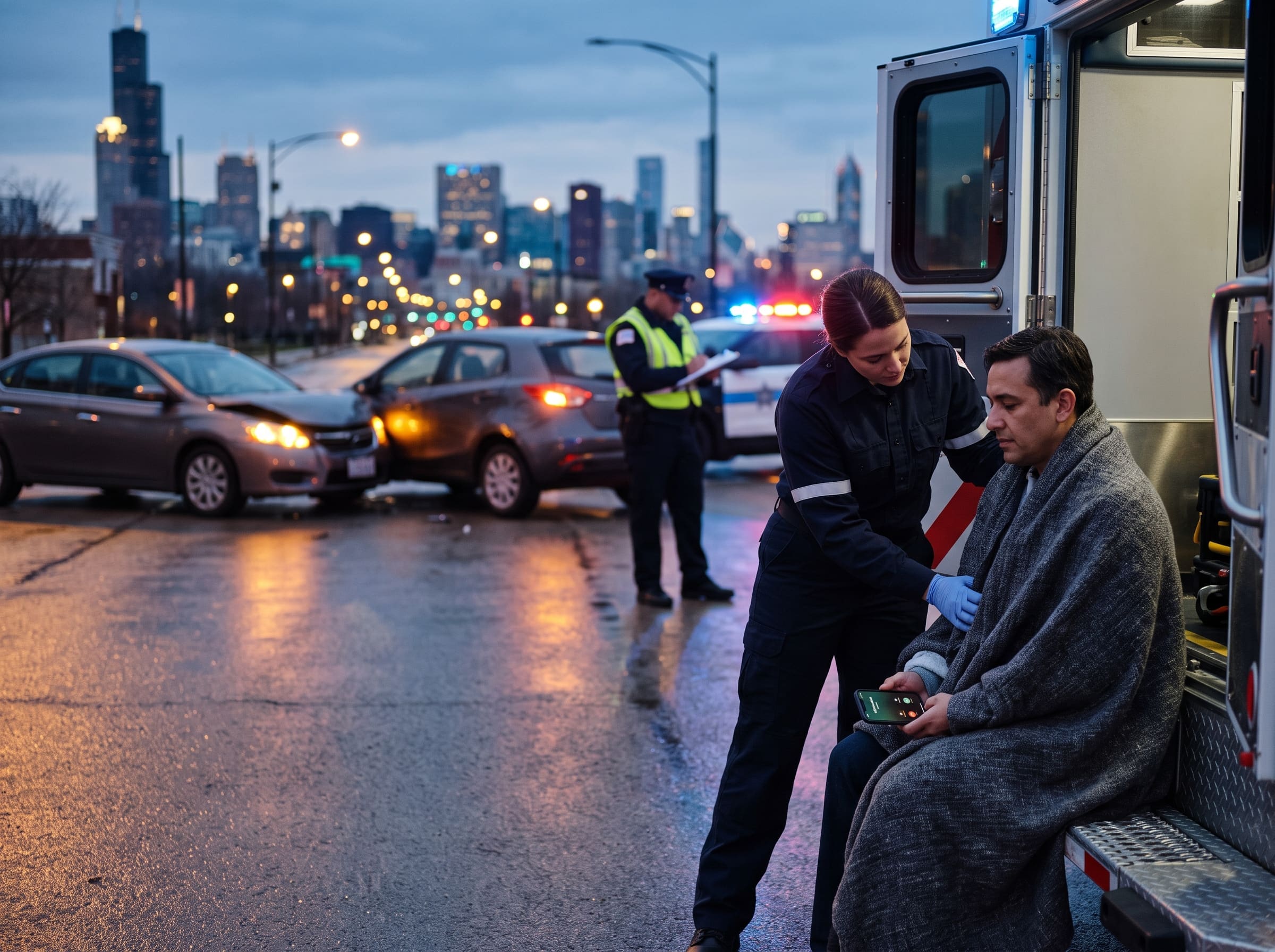
- Accept the ambulance ride and a medical evaluation, even if you think you can tough it out.
- Call 911 so police can respond and document the crash.
- Photograph the vehicles, the scene, visible injuries, and any traffic signals or road conditions.
- Collect names, phone numbers, and insurance details from other drivers and witnesses.
- Decline to discuss fault or give a recorded statement to any insurance adjuster.
- Follow every discharge and follow-up instruction from your medical providers.
Why Refusing the Ambulance Can Lower the Value of Your Case
It is common to wave off the paramedics and drive home. If pain gets worse and you go to the hospital later that evening, the claim is already worth less than it would have been had you taken the ambulance ride.
The reason is how the record reads. An ambulance transport shows that the injury was apparent right away. A delayed hospital visit gives an adjuster room to suggest the injury was not serious, or that something else caused it. Some injuries do not show their full extent for hours or days, so a prompt evaluation protects both your health and your claim.
Do You Have to Give the Other Insurance Company a Recorded Statement?
No. You are not obligated to speak with the other driver’s insurance adjuster, and you can refuse to give a statement. You also do not have to agree to be recorded.
Our advice is to decline, especially until you have spoken with an attorney. In some situations, a recorded statement can be given safely. Even then, the person should be prepared on what questions are coming and what to watch for. If an adjuster is pushing to move fast, that urgency is itself a reason to slow down. You have time to think.
Call 866-699-3339 or fill out the form at the bottom of the page.
What Is the Biggest Trap Insurance Companies Set After a Crash?
The biggest trap is the early phone call asking for a recorded statement. It often starts friendly: “How are you feeling?” If you say you are not doing well, the adjuster may follow with, “Can we talk about the accident a little bit?” Once the recording starts, the questions are phrased in ways that can hurt you.
A classic example is: “Did you see the other car before the accident?” Many people instinctively answer, “No, I didn’t see him.” That is a bad answer. It can be used to suggest you were not paying attention, even if the other driver caused the crash.
| Adjuster Approach | Why It Is Risky | Safer Response |
|---|---|---|
| Friendly check-in about how you feel | Casual answers can be recorded and used to downplay injuries | Say you are focused on your recovery and end the call |
| Request for a recorded statement | Questions may be framed to create doubt about fault | Decline and say you will not give a statement at this time |
| Quick questions about what you saw | Short answers like “I didn’t see him” can be used against you | Do not answer; speak with an attorney first |
| Pressure to settle early | Full injuries and medical costs may not be known yet | Wait until you understand your treatment and prognosis |
What Are Your Legal Rights After a Car Accident in Cook County?
If someone else’s negligence caused your crash, you may be entitled to pursue compensation for injuries and related losses. You have the right to:
- Decline a recorded statement to the at-fault party’s insurer.
- Choose your own medical providers and follow your doctors’ advice.
- Consult a personal injury attorney before making any decision about your claim.
- Take the time you need before accepting or rejecting any settlement offer.
Illinois law sets strict deadlines and fault rules that can affect your claim, so confirm the details that apply to you with an attorney. Our personal injury lawyer page explains how we approach these cases.
What Evidence Strengthens a Personal Injury Claim After a Car Accident?
Strong claims are built on consistent, documented facts. Helpful evidence includes:
- The police report and responding officer information.
- Photos and video of the scene, vehicles, and injuries.
- Ambulance and hospital records showing prompt treatment.
- Follow-up medical records and bills.
- Witness names and contact details.
- Notes on pain, missed work, and daily limitations as they develop.
Medical documentation from day one matters most because it ties your injuries to the crash.
What Common Mistakes Hurt a Car Accident Claim?
- Skipping the ambulance or delaying medical care.
- Giving a recorded statement to the other insurance company without preparation.
- Answering “Did you see the other car?” without understanding how it may be used.
- Focusing on the car or the insurance process before focusing on your health.
- Accepting an early settlement offer before your injuries are fully understood.
- Posting about the accident or your activities on social media.
If you were hurt as a pedestrian, a cyclist, or in a truck collision, similar principles apply. See our pages on pedestrian accidents, bicycle accidents, and commercial truck accidents.
How Long Does a Personal Injury Settlement Take?
There is no set timeline, and no honest attorney can guarantee one. The length of a case depends on how long your medical treatment lasts, how clearly fault is established, how the insurer responds, and whether the case settles or needs to be filed in court.
An early offer may arrive before you know the full extent of your injuries or costs. That is one reason a quick offer is often a low one. Waiting until your treatment picture is clearer helps you evaluate any offer fairly.
How The Total Guard Approach® Supports You During the Vulnerable Weeks After an Injury
At Wachowski Law Firm, we built The Total Guard Approach® to protect clients during the vulnerable period after an injury. It includes credit protection and lien reduction, so medical bills and financial pressure do not push you toward a bad settlement. While we handle the insurance company, you can focus on healing.
If you were hurt in a crash in Chicago, Cook County, or DuPage County, you can also start with our personal injury case help form or visit our contact page.
Call 866-699-3339 or fill out the form at the bottom of the page.